Haskap variety 6 of 11
Larissa / Wojtek
Get to know this variety and where it fits in the usual ripening order at Camerise St-Gabriel.
Usual ripening order at our orchard: 6 of 11
Five quick facts
- Usual period
- Mid-season
- Flavour
- Published sweet-tart balance
- Texture
- To be refined from our harvests
- Best use
- Fresh comparison in mid-season
- Picking
- Very low branches; a small stool helps adult pickers
This cultivar of Polish origin is described as sweet and tart by the supplier.
The orchard confirms the Larissa / Wojtek naming. In our usual order, it follows Aurora and precedes Boreal Blizzard.
It is a useful point of comparison with the varieties before and after it, depending on what is ripe on the day you visit.
GROWN AND OBSERVED HERE
What we observe at Camerise St-Gabriel
These practical notes come from our own plants, harvests and visitor experience. They can vary with ripeness, weather and the season.
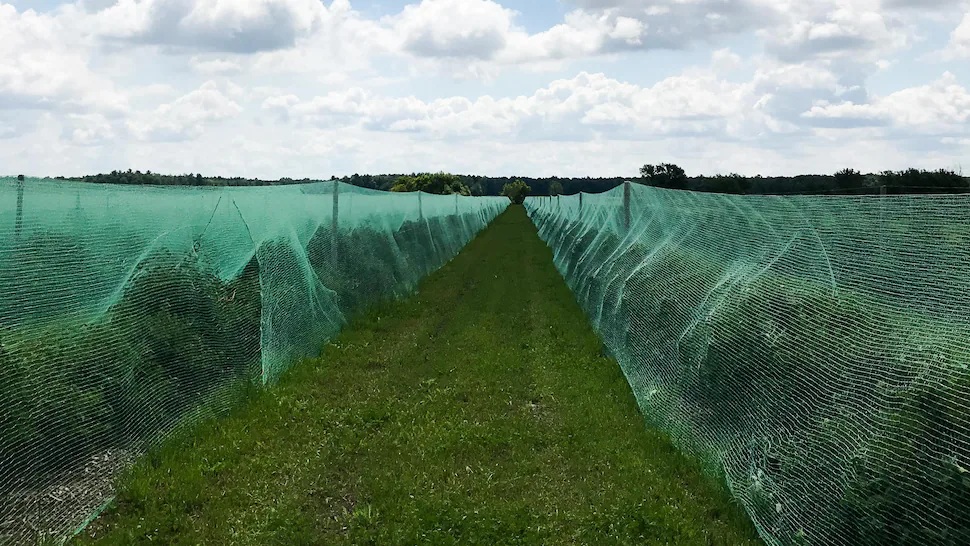
- In our rows, the branches spread strongly to the sides, even more than those of Indigo Gem.
- The weight of the crop can pull the branches even lower; some end up very close to the ground and may occasionally touch it.
- This low height works well for children. For adults, a small stool helps avoid remaining bent over while picking.
Published descriptions and background
Origin and identity
Larissa / Wojtek is a Polish selection associated with Sophia Łukaszewska. Canadian suppliers also use Larisa, Larissa or Wojtek; the orchard has confirmed that Larissa / Wojtek matches its plants.
Taste and texture
Published descriptions point to a flavour that is both sweet and tart rather than simply mild. The strength of each sensation can vary with ripeness.
Fruit and picking
The supplier describes long oval berries. Here, Larissa / Wojtek follows Aurora and precedes Boreal Blizzard. Published mechanical-harvest trials do not establish how easy it is to pick by hand.
Fresh or prepared
If you like a more pronounced sweet-tart balance, compare it fresh with Aurora when the harvest allows. It can also be cooked, though we have not established a recipe in which it outperforms other varieties.
What we will continue to observe here
To document at our orchard: how its tartness changes through full ripeness, its texture, and how it holds up after picking.
The ripening order comes from our orchard observations. Varieties may overlap, and weather changes timing, flavour and berry size. Published measurements come from other growing sites and do not indicate what can be picked today.
Sources and context
Published fruit descriptions come from the sources below; they are not measurements made at our orchard. The usual ripening position is our own observation.